


What makes the movements of tai chi appear simultaneously fluid and strong is the maintaining of connectivity and concentration while performing the entire form. Watch any master or adept practitioner and from the raising of the arms in the opening movement to the lowering of the arms at the end, profound concentration, connection, and relaxation are present. Tai chi is similar to dance, but it’s clear that something slower and different is taking place. Tai chi matches yoga in full-body integration, relaxation, and concentration, but something additional is allowing this sensation to be maintained throughout movements and not just in static postures. Strong, relaxed, connected movement is obtained by applying the concept of Silk Reeling throughout your form.Silk Reeling is an extremely misunderstood and mystified set of movements. On one hand, they are indeed a fairly simple and repetitive part of tai chi practice. For this, they suffer a reputation of being basic or unimportant.
On the other hand, every master describes the necessity and benefits of doing silk reeling exercises. To that point, I can’t think of a single class, workshop, or private lesson that hasn’t at least began or ended with silk reeling.
Silk reeling (Chan Si Gong) is a series of repeated exercises employed to cultivate whole-body connectedness and connectedness to the ground through movement. “Chan Si Jin” or Silk Reeling Energy is present in the spiraling movements of tai chi when practiced correctly. The majority of the silk reeling exercises are found within the various tai chi forms. In silk reeling however, you typically stand in one place and practice the move in isolation for several repetitions and then reintegrate it back into the form.
Silk Reeling is an extremely misunderstood and mystified set of movements. On one hand, they are indeed a fairly simple and repetitive part of tai chi practice. For this, they suffer a reputation of being basic or unimportant. On the other hand, every master describes the necessity and benefits of doing silk reeling exercises. To that point, I can’t think of a single class, workshop, or private lesson that hasn’t at least began or ended with silk reeling.
Tai chi practitioners who incorporate silk reeling into their training benefit immensely. Not only that, but silk reeling exercises serve as a kind of invisible instructor which can help you improve your movements, wake you up to internal energy, and provide you with needed feedback as to what you need to correct and focus on. All we need to do is understand a bit about the history of silk reeling, know why we would do it, and how to correctly use it to improve our tai chi practice.
Pro-tip: Silk reeling is a “foreign” topic for most of us and is best absorbed through additional learning. All tai chi schools should incorporate silk reeling into their classes. If not, or if you do not attend a class, there are many books that have been written and translated on the topic as well as plenty of videos online. Our time here is best spent learning about silk reeling to gain a respect for its importance and an understanding of what it is and how we can benefit from silk reeling exercises.
Read down to get an understanding of what silk reeling is and then we show you some videos and a download so that you can add it to your practice.
What’s in a Name?
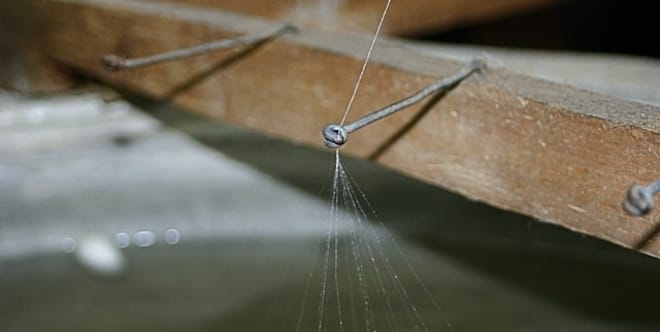
The name silk reeling is derived from the way silk is gathered from the silkworms. Constant deliberate tension is used to draw silk thread out. If the thread is pulled too hard it breaks. If it is pulled too softly, nothing comes out or the strands get tangled. This name is important because it is intended to convey the intent you hold in your mind with every movement and the sensation that you are going for. Each movement is long and continual with slight tension. Connection is made to the ground through your feet and slack is taken out of the entire body so even motions of the hand are propelled by pushing from the ground or slight turns of the waist. Every movement possesses a softness but also a firmness from proper body structure.
What is the History of Silk Reeling Exercises?
The short history of silk reeling is the cornerstone of the argument for those among us that think it is unimportant. Silk reeling was not traditionally practiced and only grew in use in the 19th Century. Here is why the nay-sayers among us should reconsider their stance: Prior to the 1900s, correct power, energy, and movement were obtained by a tremendous amount of practice. Grand Master Chen Fake (fah-kuh) was reported to do the long form 10 times each day. With an increase in demands on the individuals in a modernizing China, Silk Reeling Exercises were introduced to still produce the desired outcome in practitioners.
19th generation master Chen Zhaopi explained that silk reeling was deemed necessary for learners to grasp the spiraling and rotational movement and build internal strength so that “all movements are circular, with no sharp angles or flat surfaces, no deficiencies or excesses.”
We are better off thinking of silk reeling as an update or modernization for our progress that was developed by the same Grand Masters who taught the form. It is necessary for progress – unless you practice 10 times each day! More power to you.
How are Silk Reeling Exercises Different from Just Doing Tai Chi?
Grand Master Chen Zhaopi shared that when Tai Chi Chuan is performed correctly, each movement contains Chan Si Jin (Silk Reeling Energy). This is to say that each movement contains spiraling energy with no straight lines or angles. You can see how tough this can be to maintain this energy and concentration across the 75-108 movements of the long form. Silk reeling gives us the chance to practice creating this energy in repetitive movements until they are engrained as habit and inserted back into the form.
So: Tai Chi is Silk Reeling when practiced correctly. Tai chi practice devoid of spiraling movements, isn’t tai chi. Ouch! I know. I remember early on at a workshop when I was asked to demonstrate part of the form and was told: “That wasn’t tai chi.” I was really confused and insulted! I later learned that this was the point that they were trying to make: my movements didn’t contain Chan Si Energy. If this idea is new to you, we wrote an article on tai chi energy.
How to Effectively Use Silk Reeling to Improve Your Tai Chi Practice
Silk reeling needs to be taught independently at first so that a practitioner can easily see how they are performing a movement and how performing the movement with silk reeling energy is different. Most classes I know of use silk reeling exercises as their warm-up. This is absolutely perfect but you as a practitioner need to know that you are working on developing a very specific skill, not just getting ready for practice. Yes, you will be warmed up and moving more correctly before working on the tai chi but that is the secondary reason for doing silk reeling exercises. There are three primary ways to practice silk reeling and some pointers to keep in mind throughout your work. The only other way to gain correct movement and power this quickly is by doing the form a ton or learning a tai chi ball set. Regardless, silk reeling energy will be in both.
1: Independent Silk Reeling Practice
Silk reeling should be the beginning of every class and be an additional part of every curriculum. To say or do differently would go against the way every Chinese tai chi master instructs. Without silk reeling, there really is no way to learn proper tai chi movement. As an instructor, this is clearly visible by new attendees to my class who have learned their form from watching a video. I get to bestow the same compliment that was given to me several years ago and say; “Good job learning the sequence, now let’s add tai chi power and connection to it.
Perform the silk reeling exercises that your class chooses or search online for “silk reeling exercises” and you will immediately be given a library of movements with instruction. The most common silk reeling exercises involve tracing a circle in front of you clockwise, counterclockwise, with each hand, and then with both hands. You can search: Forward/Backward Double Silk Reeling or Forward/Backward Double Big Silk Reeling.
Forward/Backward Double Silk Reeling
Forward/Backward Double Big Silk Reeling
2. Independent Practice of Specific Movements from the Form
You can take any single move or section of the form and repeat it nine times with the focus of silk reeling. This could be seen as a separate practice or the next step after familiarizing yourself with silk reeling in step above. This is one area that I think most schools or practitioners fall short on. They break the form down into repeatable sections to learn the moves, progressing forward until they have memorized the whole form. They don’t circle back through again in sections making sure that their energy and connection is correct. Instead, they perform the entire form each time with the goal of getting better. Again, kudos to anyone who learns the form. However, could you imagine a musician only playing a song all the way through once they have learned it? They take out sections, rifts, and melodies to focus on which ultimately improves the song. Do the same thing with tai chi.
3. Do the Tai Chi Form with a Focus on Spiraling Energy and Connectivity
This last suggestion almost shouldn’t be a suggestion because the tai chi form shouldn’t be completed without a focus on spiraling and connection. However, I am the first to admit that my tai chi in my early years was devoid of these two focuses because I hadn’t learned about their importance or how to do them correctly. To solely focus on silk reeling you will have to let other things go. Don’t worry about the height of your stance, allow yourself to get some moves wrong, and move as slow as possible. You will experience a completely different quality of movement that you can integrate into the entire sequence.
10 Steps to Perfect a Tai Chi Move Using Silk Reeling
Once you have a move or a sequence of moves that you are extremely confident with, it’s time to clean them up and add in the silk reeling. Perform a specific silk reeling exercise or portion of the form and evaluate yourself based on these tips:
- Keep the body upright and the spine naturally straight
- Relax the chest and let it sink
- Suspend the top of the head from a thread
- Place your tongue against the palate breathing through the nose
- Relax the shoulders down
- Sink the elbow but keep space in the armpits
- Shift weight moving from the dan tien or lower
- If the arms and legs are moving, make sure the moves are circular
- For the hand movements, the hands should never cross the sternum line, rotate your torso instead. For most movements, the hand never goes higher than the eyebrow or below the groin.
- Keep the mind calm and place your intention on slow heavy sweeping movements. If your internal energy is developed, you will feel a heaviness on your arms and hands as they travel.
Then just stick the move back into the form and look for improvement.
Silk reeling exercises make complete sense if you rinse the esoteric mud off of them and see them as movement corrections that will help you self-evaluate and improve your form. Silk reeling allows us to pull the different aspects of the form apart to practice them before putting them back together to get good tai chi. In an interview that we did with longtime practitioners, all of the their focuses eventually circled back to moving correctly which is embodied in the silk reeling exercises.