

A student recently asked for corrections on some of the basic tai chi moves and poses and I gave them. He came back the following week really deep in his stances ready to show me his progress. I took the wind out of his sails by making more corrections and realized that he spent the weekend on the internet and came back with some very different ideas.
Tai chi moves are the combination of poses and stances, posture alignment, breathing techniques, and martial application. Basic tai chi stance techniques are the foundation for correctly performing the tai chi form for both beginner and advanced practitioners.
There are general things to focus on that improve all the tai chi moves and there are also specific tips and tricks for all of the tai chi poses. Let’s start with tai chi stances technique that anyone at any level can apply to improve their form. Then we will talk about the common tai chi chuan postures and show videos to illustrate the point.
Pro-tip: After learning the tai chi moves, reading about or seeing videos about the movements can make lightbulbs go off as to how you should be moving more correctly. Check out books and resources on the tai chi form that help expand your understanding and knowledge.
Tai Chi Moves Explained
Each of the tai chi poses are surprisingly different and this can sometimes be overwhelming to a beginner. However, there are three things that each tai chi move is intended to improve: 1) health 2) power and 3) agility.
- Health: Tai chi poses maintain open “gates” so that blood can continually flow. This means that no joint is less than 90 degrees. This includes the elbows, knees, and the thigh to stomach (Kua) angle. The armpit is not collapsed. Imagery of holding a soft ball in your armpit helps envision the posture.
- Power: Good posture is key to developing the strength that comes from the tai chi stance. By keeping the head and tailbone aligned, the joints open, and blood flow to the muscle, you can take advantage of all of the mechanical forces to create speed and power.
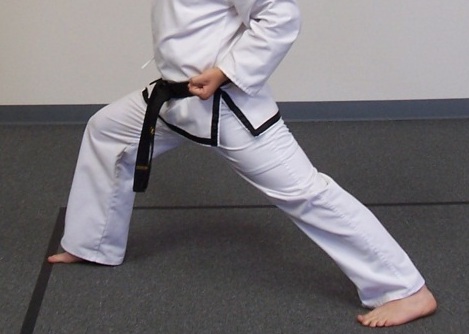
- Agility: Tai chi theory holds that you would never commit to closing down an arm or leg for some perceived advantage in strength or power. Your weight can transition between feet so that you can’t get pushed over. Your hips are typically open much like a plié in ballet so that you can advance and retreat when needed. Here is an example: Many karate stances bend the lower back and close down the rear inguinal crease (knee pointed down) in the pursuit of stability and power. This stance is not wrong as it produces strong forward moving power. Philosophically it is just different. In tai chi the lower back remains relaxed, the rear inguinal crease remains open (knee pointed out), and bent knees provide stability and agility.
Tai Chi Poses for Balance
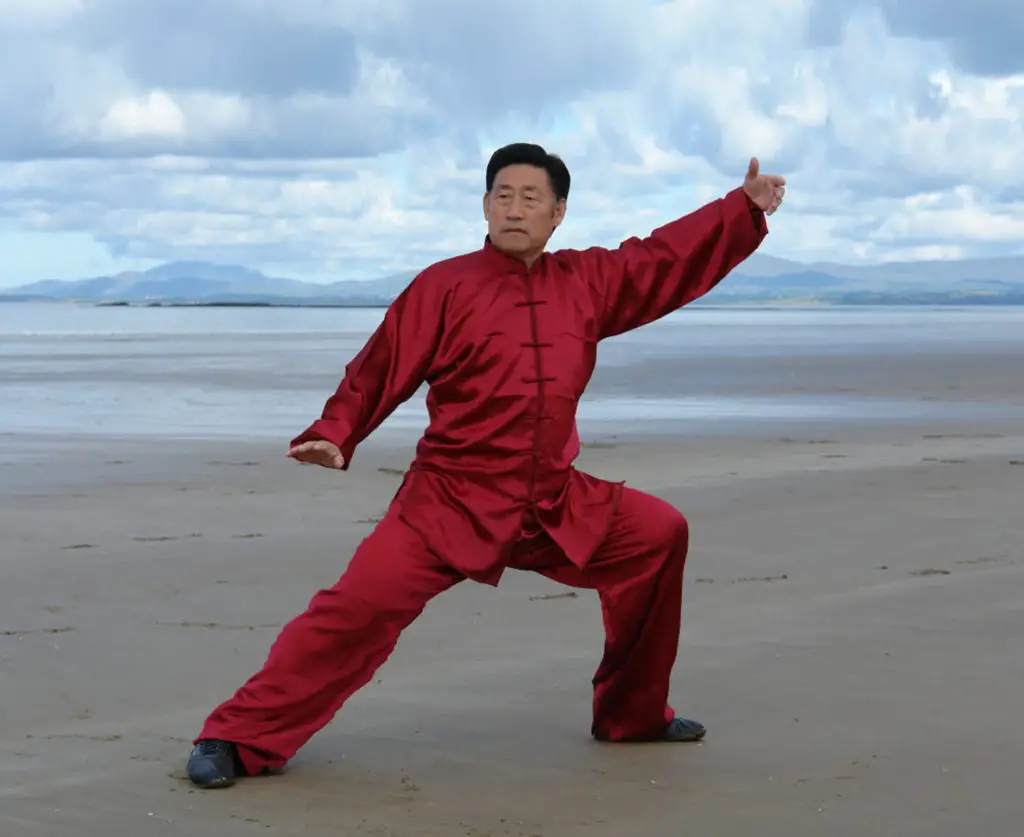
Balance in tai chi stances is a kind of final exam showing that your posture is stable and correct. It also is present in your movements because when you are stepping you are not landing with your weight on your foot but are stepping out first and then transferring your weight in what is known as an “empty step.”
There are many tai chi poses that improve balance because we are continually transitioning forward and backward slowly without falling on the receiving leg. And then there are moves that directly challenge your balance by standing on one leg such as Buddha’s Attendant Warrior Pounds Mortar or White Crane Spreads Wings. I want to be clear here: tai chi helps you improve your balance because it gives you way to practice proper alignment and proper stepping. Once you have it down in the form, it is easy to work into your daily walking and moving.
How to use the tai chi poses for balance improvements
- Soften your lower back. If your lower back is rounded forward, your pelvis will be tilted down which effectively locks your lower vertebrae. You can successfully relax your lower vertebrae by slightly tucking your tailbone and then holding the posture by slightly tensing your abdominal muscles.
- Always push up from the heel through the crown of the head.
- Keep your toe on the ground. Don’t be afraid to keep the toe of the unweighted foot on the ground while you are learning. The most important detail is that one leg holds all or nearly all of your weight. Keeping a toe on the ground lets you learn how to keep a soft back and extend through the crown of the head without wobbling the whole time. Eventually you will be able to pick up the empty foot.
- “Empty Step.” When stepping, sink on the heavy leg and step out with ZERO weight on the advancing foot. Then, transfer your weight onto the foot you just stepped with. When done correctly, it feels like you are walking on ice and testing the strength before moving forward. When done incorrectly, you fall with your weight on the foot you just stepped with and audibly hear your shoe strike the ground.
Tai Chi Stances Techniques
There are a couple easy to apply techniques that can make any tai chi stance look and feel better. These techniques are true for every stance and movement, regardless of your level. Begin by practicing them in static postures and then work to maintain the feeling while moving.
1. Push up from the crown of the head and pull down from the tailbone
The vertical expanse of the spine is extremely important because it affects how you move, feel, and most importantly to what degree you get health benefits from doing the form. By elongating the spine, you take pressure off the lower back, can breathe at your fullest capacity, take pressure off your knees while walking forward, open your chest, and raise your light of sight. Think of how different this posture is from how most people hunch over our phones.
This instruction to focus on pushing up through the crown of the head and pulling down from the tailbone simultaneously is way better than typical instructions such as “stand upright” or “improve your posture.” Those two suggestions don’t get the spine to expand which is needed to move properly.
2. Keep your armpits open
The armpits should never collapse because you have huge veins that run through this area and resting your upper arms against your rips effectively crimps the flow. The best way to visualize this is to imagine that you have to do the form while holding two racquetballs in your armpits. Additionally, during martial grappling your arm can get locked against your body so you can’t use your arm muscles effectively if you armpit is closed.
3. Don’t have a collapsed shelf – Ta Dang
The lower body is believed to support the upper body not just with the muscles of the legs, but with the arch of supporting ligaments and tissues that run along the interior of the legs and connect at the perineum. It’s easiest to imagine if you think about being a little bow-legged and sitting on an arch that runs along the insides of your legs. This arch or “dang” enables every move to initiate from the floor and transfer energy out to the torso and arms.
If you move your arms or body independently without a connection to the ground, this would be considered “ta dang” or a collapsed shelf. You avoid this by keeping the spine erect and maintaining a feeling of fullness in the foot or feet that are supporting your weight. The dang also contributes to power and agility. Imagine pushing someone by connecting through the rear heel all the way out to the point of contact with their body. This is the type of imagery or sensation that you should have throughout the form.
4. Have the height of your stance match your ability
We all want deep beautiful stances. However, if you are not flexible enough, stable enough, or balanced enough, you will compromise your posture by trying to get lower. It is better to be in a proper higher stance than a lower one with bad posture. Deep, beautiful postures are the result of practicing correctly at an appropriate level which will pay off sooner than you think.
A tai chi stance, like the form, can be performed at three heights: low, medium, and high. Height depends on flexibility or how warmed up you are. Here are some examples. During the winter I will first do a form in a high stance and progress lower as the class continues. I will also do a high stance if I have not been practicing for a while, or if my energy is low. Some older class attendees always have a high stance. People dealing with a temporary injury like a strained knee do high stances for a couple of weeks which allow them to still make it to class and not need to take a break to get better. And lastly, I will do a form in a very low, slow stance when building leg strength is my focus.
You do not get a lower stance in tai chi from going lower. A lower stance is developed by perfecting your posture and then allowing your body to sink. You gain depth not by leaning over or closing your hip but by sliding your feet further out while the spine is still upright.
How many tai chi poses are there?
There are anywhere from 8 to 108 tai chi poses depending on the style of tai chi you are studying and the length of the form. Truth be told, there are many repetitions of the tai chi moves in the 108 move form so they are not all considered different but there are still 108 moves.
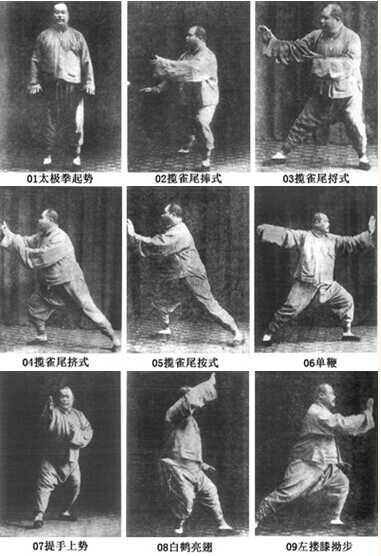
As an example, here are the yang tai chi 13 postures
- Opening Movement
- Cloud Hands
- Single Whip
- Fist Under Elbow
- White Crane Spreads Wings
- Brush Left Knee and Push
- Hand Strums the Lute
- High Pat to Horse with Palm Thrust
- Turn Body and Chop with Fist
- Step Forward, Parry Block and Punch
- Grasp Bird’s Tail
- Cross Hands
- Closing Movement
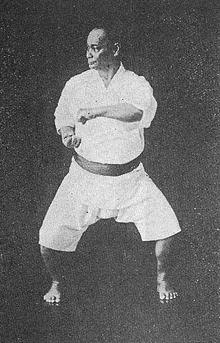
I love these old photographs! They must have been so excited when the camera was invented and they could finally capture the tai chi moves from their teachings. There are arguments to be made for learning a short form and a long form. If you are trying to choose between the two, find out why a short form might be beneficial or why a long form might be worth the time learning.
A Focus on the Basic Tai Chi Moves for Beginners and Seniors
I want to conclude by talking specifically about the tai chi stances and what practitioners should be paying attention to. There is an ideal percentage of weight that should be on each foot and specifics about knee alignment, especially in relationship to the toes.
Tai Chi Bow Stance
The tai chi bow stance is a combination of a front and horse stance. To be done correctly, 70% of your weight is on the front leg and 30% is on the rear leg. There has to be a very obvious weighting of the front leg. If the weight appears to be equally distributed it doesn’t look right. The forward knee cannot 1) cross the toe, 2) pitch inward, or 3) pitch outward. Beginners and seniors should concentrate on maintaining an upright posture, not bending forward, and not having the knee in front of the toe.
Tai Chi Empty Stance
A tai chi empty stance is a higher stance and is used to transition between tai chi moves. The weight is also distributed by about 70%/30% but this time with the rear leg carrying the heavier load. The knees stay aligned with the toes, the lower back remains flat, and there is a natural arch along the inside of your legs that you are seated upon (dang from above).
Tai Chi Horse Stance
The tai chi horse stance is a forward facing stance with the weight distributed 50/50. The distance can be wider which makes you lower. Toes are pointed out slightly with the weight on the heals. Knees are pointed out, chest posture is up and proud and the lower back is flat.
Opening Tai Chi Moves
In proper tai chi philosophical fashion, I want to end with the beginning! I have also included the longest video here below which you can watch for the first few minutes. It is a very detailed explanation of opening tai chi moves. I find it fascinating that with as different as all the styles are, with having so many different forms, the tai chi open moves of most forms are identical.
What you should get from this is that these moves are extremely important because they have not altered them much over the years and have kept them as the very first thing you do in almost every form, regardless of tai chi style. Everyone steps out to the left, raises both hands and sinks them back down before transitioning into the next move. Weight is 50/50, inhale as the hands rise and exhale as they fall. Keep your posture upright and extend out through the fingertips.
Know that all of the movements of tai chi theory are described in the Song of 13 Tai Chi Postures. This is a combination of the Eight Energies of Tai Chi and the Five Primary Movements.
Additional Reading: Tai Chi Stretching – The Unknown and Hidden Health Benefits
Thank You!
Glad you enjoyed it. Many more to come.
I just received advice from ellen asst to Mr.Hong-Chi Xiao whose exercise I have been doing for 7 years- Ihave a problem with my ballance so ellen advised me to do “Horse Stance” so I’m on my computer seeing & doing the same
The horse stance can definitely help to improve balance. Achieving a correct stance might take some personal correction but here are some general tips. You want to begin higher and not have a deep posture as a main goal at the beginning. You want to sink evenly into both legs while 1) your upper body is straight and 2) you maintain movement in the pelvis. Do not lock your pelvis by tilting it forward. Your legs should get heavy, tired, and start to burn a bit. Practicing a great posture for 3 minutes is better than a mediocre posture for 10 minutes. The overall sensation that you want to feel is that your upper body is light and your lower body is heavy.
If you are focusing on balance you want to eventually move with this sensation of heavy-low, light-above. Come out of the horse stance and try to move the heaviness from one leg into the other and now pick up the light leg. Put the leg back down and try to move the heaviness into that leg and pick the other leg up. Do not let the weight/heaviness travel into the upper body.