

Of all of the philosophical concepts related to Chinese medicine, philosophy, and martial arts, Ying Yang Theory is possibly the most foundational and most important. It has the power to be a roadmap for us to make improvements not only to our tai chi form by unearthing problems in our movements, but also has implications for our health, jobs, and even relationships. Benefitting from Yin Yang Theory is actually quite simple. We just need to know a little bit about its origin, purpose, and how we can apply it in our life.
Yin Yang Theory is a philosophical idea that describes the relationship between opposing energy, ideas, and forces. It is used as a framework for understanding how contradictory situations relate to each other, are connected, and influence each other.
We all have friends in our lives who are experts at seeing why we might be struggling with a situation when we are blind to it because we are too involved. Or, we have had great parents, teachers, or professors who were able to guide us on to higher learning because they knew what the next step was or what we were missing. This is exactly how Yin-Yang Theory can be used to make improvements in our life. It is a way for us to diagnose or assess our situation when we want some sort of change. It then provides ideas for how we can move in a direction that we wouldn’t have considered and often seems counter-intuitive.
Let’s start with the history of the Yin Yang Theory and then talk about the meaning of yin yang symbols because they are actually visuals we can use to problem solve. We will then end with a practical example for how to apply Yin Yang Theory in our lives by showing how to use the tai chi form to practice thinking in new ways.

What is Yin Yang Theory?
Yin Yang Theory is a Chinese philosophical concept developed to explain how things relate to and influence each other. At its simplest, it describes reality as a balance of opposites that are constantly interacting and changing. The original idea is often illustrated as the shady side of a hill (Yin, 阴) and the sunny side (Yang, 阳). They are not separate. They are part of the same whole, defined by their relationship to each other.
From this simple observation came a powerful way of thinking. We understand something not just by what it is, but by what it is not. We recognize imbalance by seeing where something has gone too far in one direction. And we create change by moving toward the opposite.
This is why Yin Yang Theory has lasted so long. It is not just a philosophy but is actually a practical tool. In tai chi, it helps us adjust movement. In daily life, it helps us recognize when something is off and decide what to do next.
Examples of Yin & Yang
Yin and Yang are often introduced through simple opposites like light and dark, hot and cold, or fast and slow. These examples are helpful, but the real value comes from learning how to notice these relationships in practice. In tai chi, you are not just identifying opposites. You are feeling when one side has become too dominant.
- A movement becomes too fast and loses control.
- The body holds tension instead of relaxing.
- Posture rises when it should be sinking.
These are not separate problems. They are all examples of imbalance. This is where the idea of opposites becomes useful. Each one points to a direction for change.
- If something feels rushed, explore slowing down.
- If something feels tense, explore releasing.
- If something feels unstable, explore grounding.
The goal is not to label things as Yin or Yang. The goal is to recognize when something has gone too far in one direction and gently guide it back. The traditional examples still help illustrate this idea:
| Yin (阴) | Yang (杨) |
|---|---|
| Dark | Light |
| Cold | Hot |
| Internal | External |
| Soft | Hot |
| Feminine | Masculine |
| Old | Young |
| Poor | Rich |
| Even | Odd |
| Moon | Sun |
| Earth | Heaven |
| North | South |
| Valley | Mountain |
What is intriguing and most important to be able to benefit from an understanding of Yin Yang theory is that they identified certain truths that exist in every situation. But in practice, these are not just concepts. They are signals. Each one gives you information about where you are and where you can go next.
1. Nothing occurs in isolation.
Two opposing forces almost always exist together. We know that something is light because of the dark background it is up against. We describe being sick as the absence of a normal healthy experience.
2. If something is out of balance (at an extreme) it’s problematic.
If something is too hot, dry, large, etc., we know which direction we need to go to correct it (colder, wetter, smaller). While this seems like an obvious point, most people over-correct in day-to-day situations which typically leads to an equally problematic, yet opposite situation. As an example, in college I was notorious for drinking espresso shots when tired to get through studying sessions. This led inevitably to being too jittery and wired to be able to sleep, resulting in needing a heavy dose of caffeine to make it through class the next day. Luckily, I began learning tai chi in college too and in my last year adopted short naps to easy me through my busier days. This imbalance can be seen everywhere though. From crash diets that take off weight but leave us miserable, to insane fitness challenges that leave us injured. Yin Yang Theory helps us get to the middle so that the extremes aren’t an issue.
3. Yin and Yang are dependent on each other.
Too much of ___________ (fill in the blank) is corrected by seeking the other. This is another way that the Yin Yang Theory can give us a new way of looking at things. In the West we are often programed to see things as good or bad. A flood is bad. But isn’t a drought equally bad? How can they both be true? By labeling the extremes we miss an opportunity to find permanent solutions that keep us in the middle.
4. Opposites like Yin and Yang consume each other.
This one bends the brain a bit but if you think of everything as being on a spectrum (e.g., light-dark, angry-happy) you see that less light is actually just a little more dark. We rarely go from angry to happy but instead slide along a spectrum: rage-furious-angry-mad-pessimistic-melancholy-content-optimistic-happy-blissful. So, to be less-angry is to be a little more-happy.
In Western thinking, we normally want to jump to the opposite extreme. This is problematic for two reasons: 1) That’s not typically possible and 2) it can be short lived. Take our emotions as an example: Flipping a switch from being furious to being blissful is not typically possible. If you are working with an adolescent who is in a state of rage, most of us would be relieved to move him towards being furious. And even anger would be welcomed if there was less chance of bodily harm or something getting broken. Again, in our Western thinking we usually know that we just don’t like or want our current state but crave the opposite. Yin Yang Theory leads us to the next gradual option as we transition away from what is undesirable.

The Meaning of the Yin Yang Symbol as it Relates to Tai Chi
The yin yang symbol has been used for thousands of years to represent balance and change. While it is often explained through a list of meanings, two ideas are the most useful for practice. First, the symbol shows that nothing is purely one thing. Each side contains a small part of its opposite. Even in a moment of tension, there is the possibility of relaxation. Even in stillness, there is the beginning of movement. This is why change is always possible. You are never stuck in a fixed state.
Second, the symbol shows that balance is always moving. The curved line between Yin and Yang is not static. It represents a constant shifting from one state to another. Too much of one side naturally begins to turn into the other. This is exactly what we experience in tai chi.
- When we move too fast, we are guided to slow down.
- When we hold tension, we are guided to release.
- When we rise up, we are guided to sink.
The symbol is not just describing the world. It is showing us how to adjust. Instead of trying to be perfectly balanced, we learn to notice when we have gone too far in one direction and gently move back. Over time, this becomes a way to measure progress. You are not asking, “Am I doing this perfectly?” You are asking, “Which direction do I need to move next?”
Practicing Yin Yang Theory with Tai Chi
Yin Yang Theory is simple in concept, but applying it in real time is where the value lies. The challenge is not understanding the idea. The challenge is catching ourselves in the moment, recognizing what is happening, and then moving gently in a better direction. For most of us, this way of thinking is not automatic. We react. We assume we are already doing things correctly. We push forward. Tai chi gives us a place to slow that process down and practice a different approach.
When we practice tai chi, we are constantly trying to match what we see from a teacher or a more experienced student. We move through the form, doing our best, and then we hear the same kinds of corrections. Relax more. Slow down. Sink. Adjust your posture. The surprising part is that these corrections often feel wrong.
- You feel relaxed, but you are told to relax more.
- You feel slow, but you are told to slow down.
- You feel stable, but you are told to adjust your position.
This is where Yin Yang Theory becomes practical.
Instead of arguing internally or getting frustrated, we can use the idea of opposites. If you are being asked to relax, then somewhere there is tension. If you are being asked to slow down, then somewhere you are moving too quickly. If you are being asked to sink, then somewhere you are rising. The correction is not random. It is pointing you toward the opposite state.
One of the simplest ways to find that opposite is to exaggerate it. If you are told to relax, first feel what tension actually is. Tighten your shoulders. Clench your hands. Hold your body rigid. Then release it, piece by piece. That contrast teaches your body something it could not feel before. If you are told to slow down, explore what “too fast” feels like. Notice where your timing breaks down, where your balance becomes unstable, where movements lose connection. Then begin to reduce the speed until everything stays connected and controlled. If you are told to sink, notice the tendency to rise. Feel how the body subtly lifts to avoid effort or discomfort. Then allow the weight to settle down through the legs. In each case, you are not just correcting a movement. You are training awareness. You are learning how to identify an imbalance and move toward its opposite.
Over time, something important begins to happen. You realize that your body and your perception are not always in agreement.
- You can feel relaxed and still be holding tension.
- You can feel slow and still be moving too quickly.
- You can feel low and still be rising.
This gap is not a mistake. It is part of the process. The body often defaults to what is familiar, what feels efficient, or what avoids discomfort. It will tell you that you are doing something correctly because that is the easiest path, not because it is the most accurate one. Tai chi gives you a safe way to uncover this and this is where the connection to life becomes clear because the same pattern shows up everywhere:
- We think we are managing stress well, until something breaks.
- We believe we are communicating clearly, until a relationship struggles.
- We assume we are doing well at work, until feedback says otherwise.
Just like in tai chi, the issue is not a lack of effort. It is a lack of awareness of what is actually taking place within around us and how are actions are being perceived or are influencing a situation. Yin Yang Theory gives us a simple process to work with this.
- Notice what is happening.
- Recognize the imbalance.
- Move, even slightly, in the opposite direction.
Too much activity calls for rest. Too much stillness calls for action. Confusion calls for clarity. Tension calls for release. Tai chi becomes the training ground for this way of thinking. Each correction is an opportunity to practice adjusting without resistance. Each movement is a chance to become more precise in how you sense and respond.
Over time, this carries into daily life. Instead of being surprised by problems, you begin to notice them earlier. Instead of reacting strongly, you make small adjustments. Instead of forcing change, you guide it. That is the real benefit of practicing Yin Yang Theory. Not just understanding balance, but learning how to create it.
Yin Yang Theory and Monitoring Progress in Push Hands
I want to end this section by showing that Yin Yang Theory is valuable at every level of tai chi development. It is not something that is learned and then moved past. It is applied continually as we move through each stage in life.
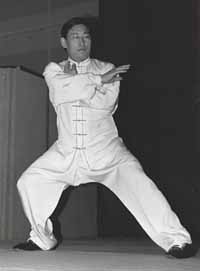
A great example of this idea comes from push hands training and how progress is described by Grand Master Chen Xiaowang. In a workshop, he explained that development in push hands can be understood through Yin and Yang. Not in an abstract way, but as a way to monitor where you are and how to improve.
One of the first things to accept is that progress does not start balanced. It moves from hard to soft. From external effort to internal control. From too much Yang toward increasing Yin.
In other words, we begin out of balance and gradually work toward it. He described this through a translator as simple ratios.
- At the beginning, a student might be described as 90% Yang and 10% Yin. There is a lot of force, tension, and effort, but very little sensitivity or control. A person at this stage may occasionally succeed, but often loses balance or overcommits. As training continues, the balance begins to shift.
- At 80/20, there is some ability to respond, but mistakes are still common. Movements may be too forceful or poorly timed.
- At 70/30, things improve, but there is still stiffness and too much reliance on strength.
- By the time a practitioner reaches 60/40, something important changes. They can begin to neutralize incoming force, adjust more quickly, and respond with better timing and accuracy.
- The goal is not to eliminate Yang. It is to balance it.
- At the highest level, the description becomes 50/50. Yin and Yang are in constant relationship. There is structure and softness, responsiveness and stability, action and restraint. Nothing is excessive and nothing is missing.
What makes this useful is not the exact percentages. It is the process. You can look at your own practice and ask:
- Am I using too much force?
- Am I too stiff?
- Am I collapsing or overextending?
Each question points to an imbalance. And just like in the form, the solution is not complicated. You move in the opposite direction.
- Too much force becomes a focus on softness.
- Too much stiffness becomes a focus on relaxation.
- Too much hesitation becomes a focus on clear, decisive movement.
This is the same skill you are practicing when your instructor tells you to relax or slow down. Push hands simply makes the feedback more immediate. Over time, you begin to feel where you are on that spectrum without needing to be told. You can sense when you are too far toward one side and make small adjustments. That is the real lesson.
Yin Yang Theory is not just something we understand. It becomes a way to measure progress, guide correction, and refine our movement. And just like in life, the goal is not perfection. It is the ability to recognize imbalance early and respond with the right amount of change.
Learning to “relax” can be charged with frustration and is a suggestion that is often seen as a criticism. It is time to view it in its intended light: your relaxation charts your progress.
Here is a great online course covering important tai chi concepts and theory:
Tai Chi Theory with Master Yang, Jwing-Ming
Master Yang reveals the secret to transforming your Taiji practice into your own personal art-form. He explains the development of the internal and external aspects and different styles of Taiji by taking us back to the root of this ancient art.

References:
- Needham, Joseph; Science and Civilization in China Vol.2: History of Scientific Thought; Cambridge University Press; 1956
- The Yin Yang Property of Chinese Medicinal Herbs Relates to Chemical Composition but Not Anti-Oxidative Activity: An Illustration Using Spleen-Meridian Herbs